Phys.Org |
|---|
Three-dimensional visualization of nanoplastic distribution in the neonatal mouse brain |
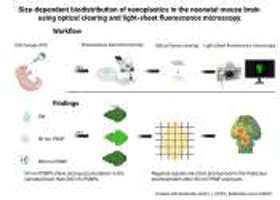
Nanoplastics—plastic particles smaller than one micrometer—are generated through the degradation and abrasion of plastic products and are increasingly detected in food, drinking water, air and biological tissues. Although ... |
||
|
2026-07-30 Read more about this article in source |
||


-

The energy system of the future will require sustainable catalysts that, for example, enable the efficient production of green hydrogen. Materials consisting of mixtures of five chemical elements show great promise for enabling ... 07/31/2026
-

What if glowing molecules could synchronize, much like fireflies flashing in unison? Researchers have discovered that molecules confined within tiny gold nanostructures can behave collectively, coordinating their interactions ... 07/31/2026
-

Researchers 3D-nanoprinted hollow-core Photonic Scaffolds with up to 80% cladding openness, with models predicting attenuation at or below 1 dB/mm at that openness and experiments measuring sub-1 dB/mm losses at 68% openness. The waveguides supported dye diffusion in about 34 seconds, a 1.4 nL effective interaction volume, and quantum-dot emission with output photon statistics consistent with single-photon emission after transmission. 07/30/2026
-
Phys.Org more ...
An atom-holography microscope for direct visualization of 3D atomic arrangements in nanoscale regions

A collaborative research group led by Hiroshi Daimon, a specially appointed research fellow at the Institute for Molecular Science, National Institutes of Natural Sciences, has developed an "atom-holography microscope" capable ... 07/30/2026
-
Springer more ...
Effect of Glutaraldehyde on the Properties of PEO/Chitosan Nanofiber Membranes for AC Air Filters

Polyethylene oxide (PEO) chitosan (CS) nanofiber membranes are promising for air filtration due to their biodegradability and antibacterial... 07/30/2026
-
Phys.Org more ...
Three-dimensional visualization of nanoplastic distribution in the neonatal mouse brain

Nanoplastics—plastic particles smaller than one micrometer—are generated through the degradation and abrasion of plastic products and are increasingly detected in food, drinking water, air and biological tissues. Although ... 07/30/2026
-

Researchers found that deep-sea carbonate fluorapatite comprises apatite nanocrystals embedded within an amorphous matrix that primarily hosts samarium, used as a probe for rare earth elements. This disordered nanoarchitecture helps explain why rare earth elements can be readily extracted by acid leaching despite fluorapatite’s low solubility. 07/29/2026
-

As materials become thinner—now reaching the thickness of single atoms—it has become increasingly difficult to create sufficiently large sheets and transfer them without cracking them into tiny flakes. Recent work by a broad ... 07/29/2026
-

Recent studies reveal how environmental weathering of polystyrene leads to nanoplastics, prompting innovative solutions through nanotechnology and microbes. 07/29/2026
-

A systematic review of 212 studies linked experimental exposure to microplastics and nanoparticles to oxidative stress, impaired growth and reproduction, and increased mortality across biological models. Smaller particles, higher concentrations, and polystyrene were associated with stronger effects, although laboratory conditions and limited human evidence restrict conclusions about real-world health risks. 07/28/2026
-

A review proposes an integrated framework linking feedstock engineering, scalable processing, structural control, quality assurance, sustainability, and regulation to improve industrial nanocomposite production. It finds that AI, digital twins, real-time monitoring, and closed-loop control could improve production consistency, although data, validation, infrastructure, and standardization barriers still limit adoption. 07/28/2026
-

The growing demand for sensitive, rapid, and reliable analytical techniques for human health and environmental monitoring has driven the development... 07/26/2026
-

Hybrid bonding advances semiconductor packaging, enabling compact assemblies with high performance and reliability for next-gen microelectronic devices. 07/08/2026
-

KLA Instruments' SRX option transforms nanoindentation, addressing high-strain-rate testing challenges and improving understanding of material performance. 07/14/2026
-

The discovery of non-porous MOF thin films has altered our understanding of their stability and transport properties. We take a closer look. 07/15/2026
-

Optimize materials design with KLA's SRX nanoindentation workflow, focusing on strain-rate sensitivity for improved understanding of rate-dependent behavior. 07/24/2026